Today we're releasing Solar Open 2, our open-weight foundation model optimized for agentic use.

Solar Open 2 is designed and trained to serve as the base model for agents in real work environments. It's trained on a wide range of agent scenarios, including tool calling, coding, and office work, and delivers performance that competes with leading global models across agent, Korean, knowledge, and coding benchmarks.

The model adopts an MoE architecture that activates only 15B of its 250B total parameters per token, improving capability and inference efficiency at the same time. With quantization, it runs on two NVIDIA H200 GPUs, which makes it practical for enterprises to deploy and operate on their own infrastructure. Built for agent tasks that run across many steps, it supports a context window of up to 1M tokens and comes with official support for Korean, English, and Japanese.

The model weights are released on Hugging Face under a commercially usable license. Alongside them, we publish the Solar Open 2 Technical Report, covering the full architecture, training methodology, key experiments, and evaluation conditions.

Key highlights

  • Designed and trained for agentic use, ready for real work environments
  • Competes with leading global models across agent, Korean, knowledge, and coding benchmarks
  • 250B total / 15B active MoE architecture for efficient inference
  • 1M-token context window
  • Runs on two H200 GPUs with quantization
  • Officially supports Korean, English, and Japanese
  • Released as open weights with commercial use permitted

From chat to agents

The role of LLMs is changing.

Until now, LLMs mostly generated a single answer to a user's question. They are now expanding into agents that search for information, read across documents, write code, and call external tools to carry real work through to completion.

The work agents handle is different in kind from chat. Instead of answering a short question, an agent repeats dozens of reasoning steps and tool calls. It has to work with information scattered across files and documents, remember what it has already done, and decide its next action accordingly. A mistake at one step can fail the entire task downstream.

Agentic use demands three capabilities.

  • First, long-horizon task execution: carrying multi-step work through to the end.
  • Second, long-context processing: holding long documents and work history in view.
  • Third, following instructions precisely and calling the right tools reliably.

These capabilities are hard to learn from ordinary question-answering data. The model needs to experience agent scenarios during training: search, tool calling, coding, document work. And the scenarios can't just look plausible. They have to reflect real work environments, and we have to be able to verify that the model actually completed the task.

Cost matters too. An agent doesn't stop at a single model call; it cycles through planning, execution, verification, and revision, so it typically uses far more tokens than chat. For an enterprise to deploy the model on its own infrastructure, the model can't be too large or too slow.

We built Solar Open 2 to be more than a model with high benchmark scores: a model with the performance and cost structure to power agents in real work environments.

Agent-centered training data

We developed Solar Open 2 with agentic use as a primary goal across both pre-training and post-training. Training scenarios cover search, tool calling (MCP), coding, and office work. The model learned not just to generate explanations, but to act in real environments, check the results, and correct itself when needed.

To build realistic agent training data, we developed our own data synthesis and verification pipeline. Starting from source data drawn from real work environments, we constructed settings where correct answers can be determined unambiguously, then repeated the process of selecting only the data that passed verification. Only this high-quality agent data went into training.

Search

Search agent data distinguishes between questions the model can answer with what it already knows and questions that require actual retrieval. Generated questions pass through multiple verification stages checking structure, non-triviality, searchability, solvability, and grounding in sources. This teaches the model to reach for search when it encounters knowledge it doesn't have.

Tool calling

Unlike conventional approaches that only judge whether the model selected the right tool, we have the model execute changes in a real environment, then read the changed state back to verify the result. The point is to separate generating a plausible answer from actually completing the task. This trains the model to take actions that can be trusted, not just to produce responses that sound right.

Coding

The coding agent works in a terminal, then writes and runs its own tests. When tests fail, the training data includes the loop of fixing the code and verifying again. The model learns how to work through long-horizon tasks: correcting mistakes and ultimately reaching the goal.

Office work

Office work scenarios reflect real working environments: cross-checking information scattered across documents and spreadsheets, changing inputs in a spreadsheet with formulas and recalculating the results, and other tasks close to actual daily work. We specifically included document handling and tool-use scenarios common in Korean workplaces. The goal was not just to generate fluent Korean, but to actually carry out work given in Korean.

A 1M-token context for long tasks

The longer an agent works, the more information it has to hold. To navigate a large codebase, compare multiple documents, and decide the next action based on earlier tool results, the model has to take in and process a long context.
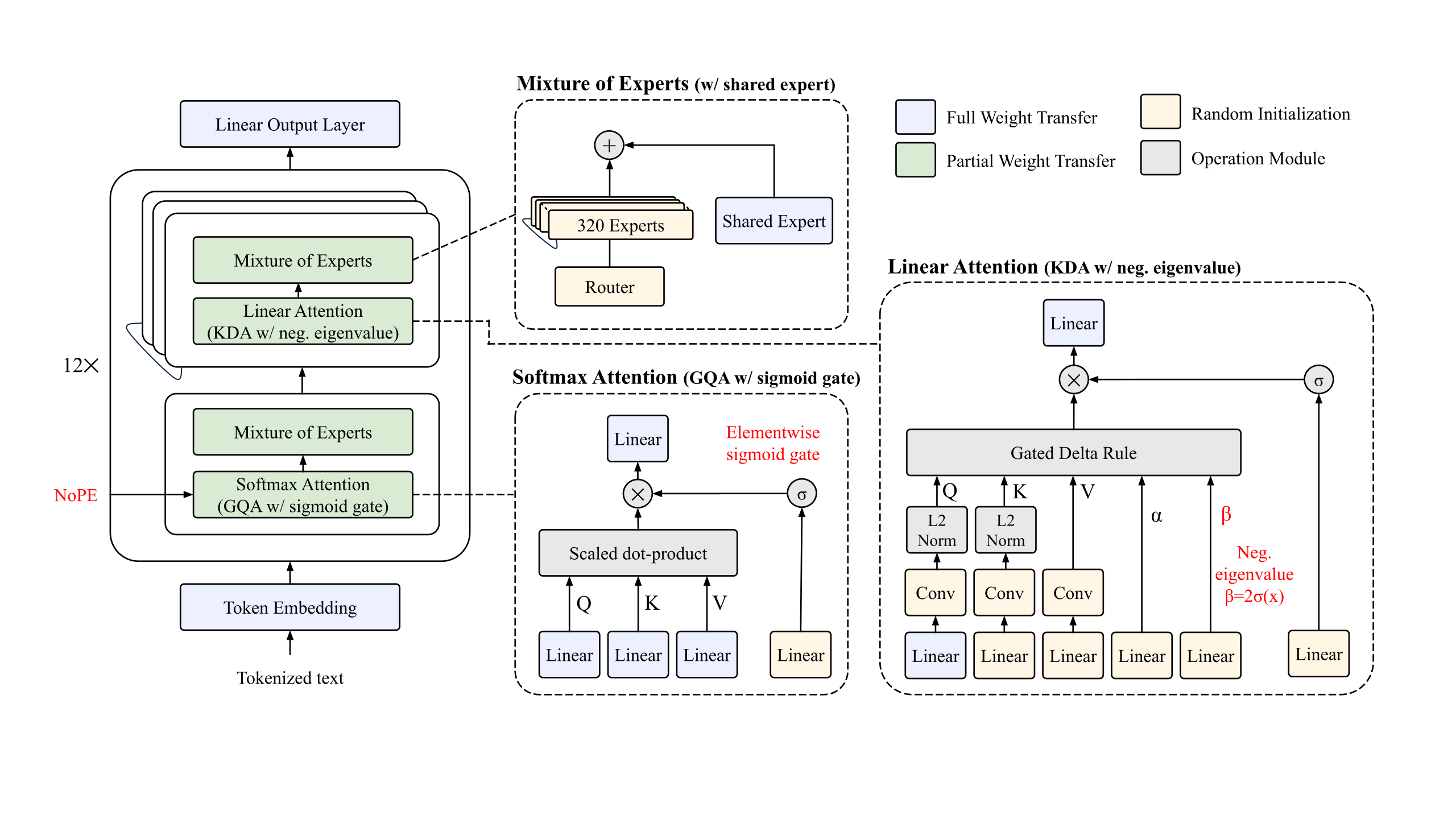
Solar Open 2 supports a 1M-token context window. To support long context, it uses a Hybrid Attention architecture combining GQA (full softmax attention) with linear attention. The model repeats blocks of one GQA layer and three linear attention layers, applying linear attention to 75% of its 48 layers.

Linear attention layers manage sequence information in a fixed-size state. This avoids having every layer's KV-cache grow in proportion to context length, and reduces the memory burden of long inputs.

The softmax attention layers adopt NoPE, applying no positional encoding. This choice targets extrapolation: handling inputs longer than the lengths the model mainly saw in training.

The effect shows up in training efficiency as well. In a controlled comparison, the Solar Open 2 architecture reached in 210B tokens the MMLU performance that Solar Open 100B's all-softmax architecture needed 671B tokens to reach. The detailed comparison and design rationale are published in the Technical Report.

Inference efficiency for repeated calls

In an environment where agents call the model repeatedly, inference cost becomes product cost.

Solar Open 2 uses an MoE architecture that activates only 15B of its 250B total parameters per token. The design keeps the knowledge and representational capacity of a large model while lowering the active computation needed to process each token.

Solar Open 2's feedforward network (FFN) consists of 320 routed experts and 1 shared expert, with 8 experts selected per token. Unlike dense models that activate every parameter every time, it uses only the experts the input needs.

This inference-efficient architecture lets Solar Open 2 keep its performance while running on relatively small infrastructure: four NVIDIA H200s for the BF16 model, or two H200s with quantization.

We set these requirements with deployment in mind, not just research evaluation: enterprises running the model on their own infrastructure and connecting it to agent services. Detailed throughput and latency figures are provided in the model card.

A multilingual model efficient in Korean

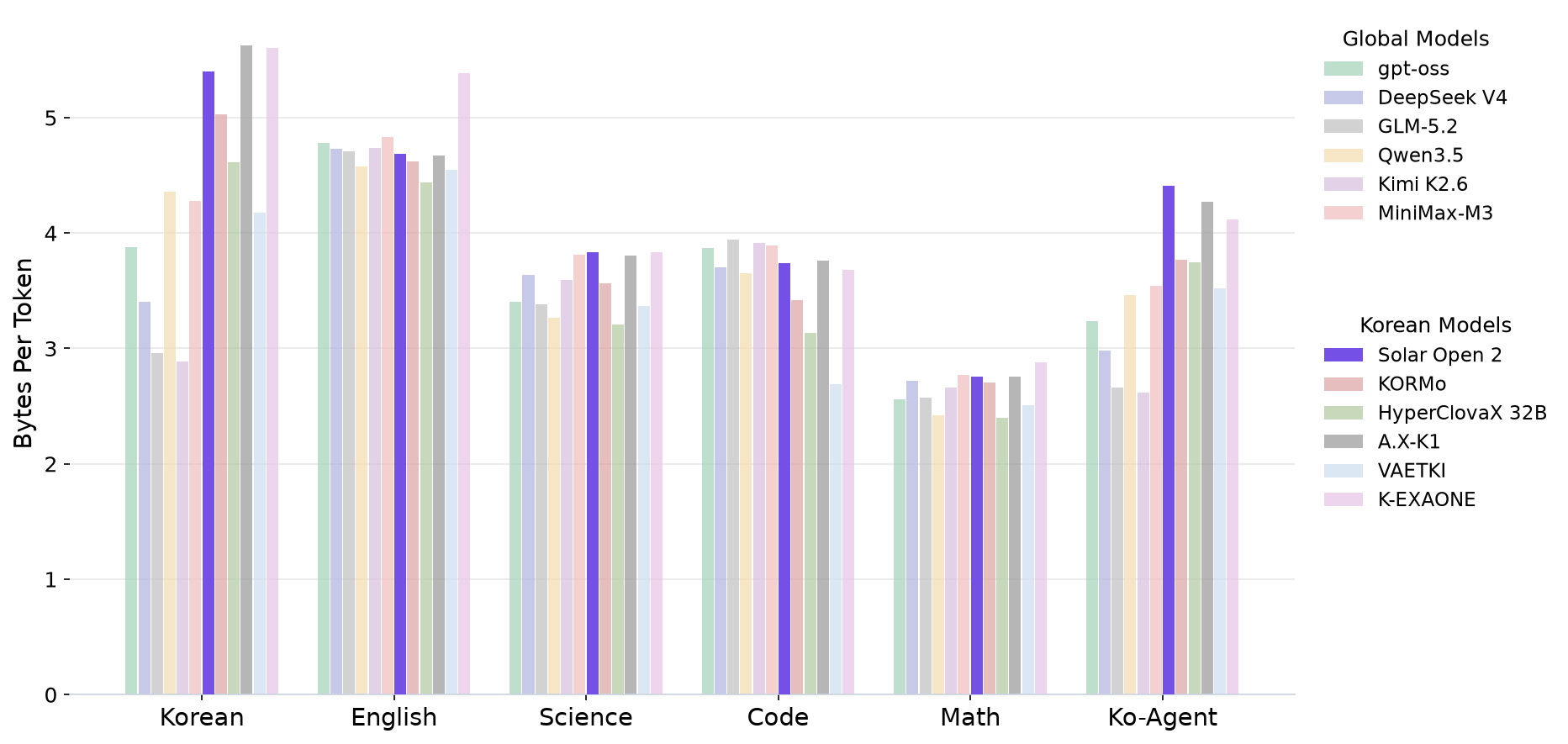
Solar Open 2 uses a tokenizer optimized for token efficiency in Korean. As a result, it processes the same Korean text with only 50 to 80% of the tokens global models use. On Korean office-work text, Solar Open 2's tokenizer is the most efficient of the 12 we compared, about 24% ahead of the best-performing global model. Expressing the same content in fewer tokens means lower inference cost and a longer effective context.
Selective Weight Transfer for efficient training
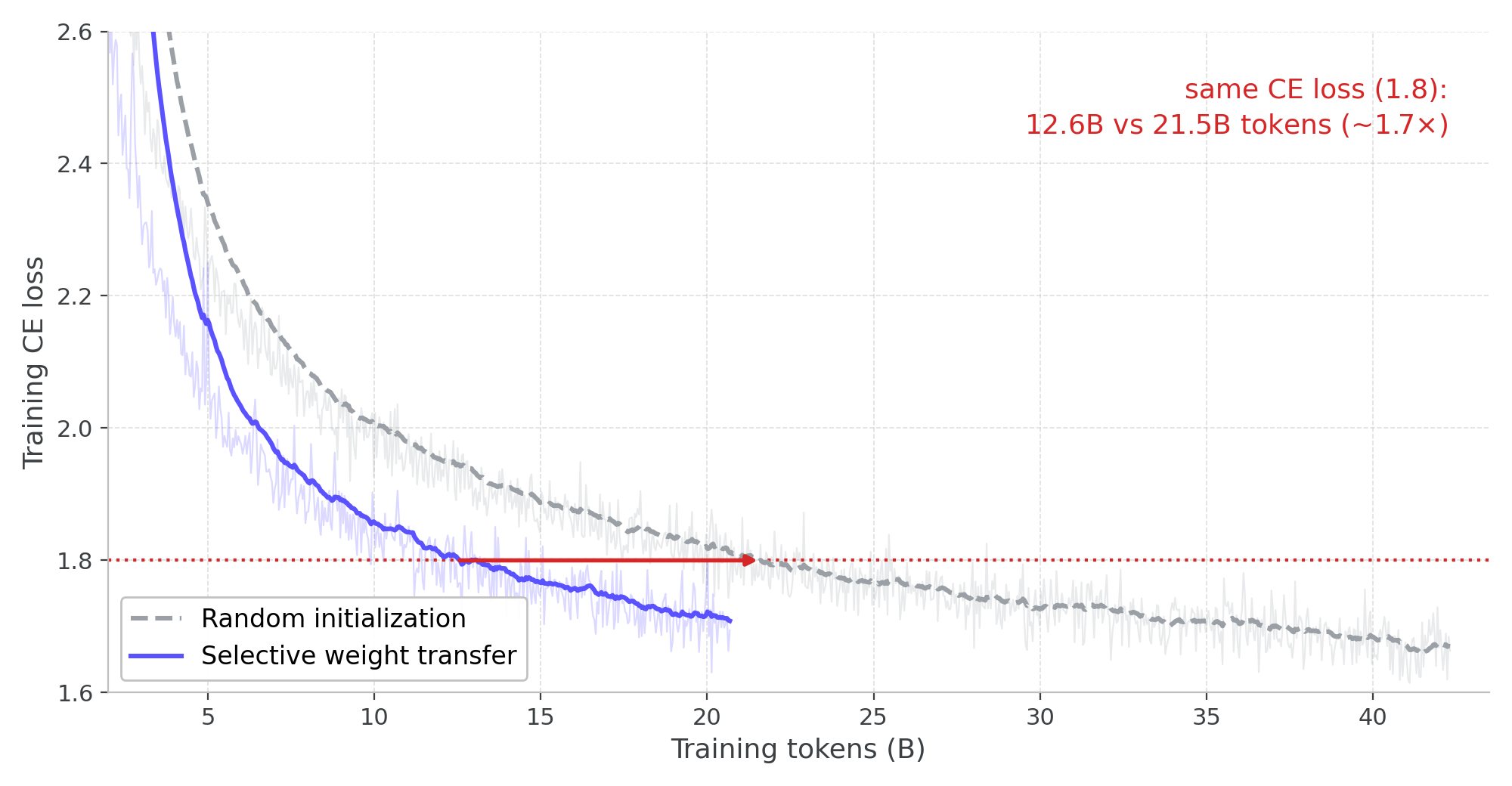
To train a 250B-scale model more efficiently, we developed our own Selective Weight Transfer method. Instead of initializing every weight at random, we took our previous model, Solar Open 100B, selected only the weights that could carry over to the new architecture, and used them to initialize Solar Open 2.

The figure shows a 200B-A15B proxy experiment in which the architecture, training data, and optimizer are held identical and only the initialization differs. The model with Selective Weight Transfer reached the target training loss in about 12B tokens, while the randomly initialized model needed about 22B. In other words, the transferred model reached the same loss with about 58% of the tokens, while random initialization took about 1.7 times more. This shows that even across different architectures, reusing the core representations alone lets the model reach the target performance level faster, with fewer training tokens.

Selective Weight Transfer is our own approach to reducing training time and compute. With this release, we improved both the model's performance and the efficiency of the process that builds it.

Benchmarks

First among comparable models in MMLU-Pro, LiveCodeBench, and Korean benchmarks

Beyond agentic use, Korean-language performance, and inference efficiency, Solar Open 2 is also competitive in core knowledge and coding.

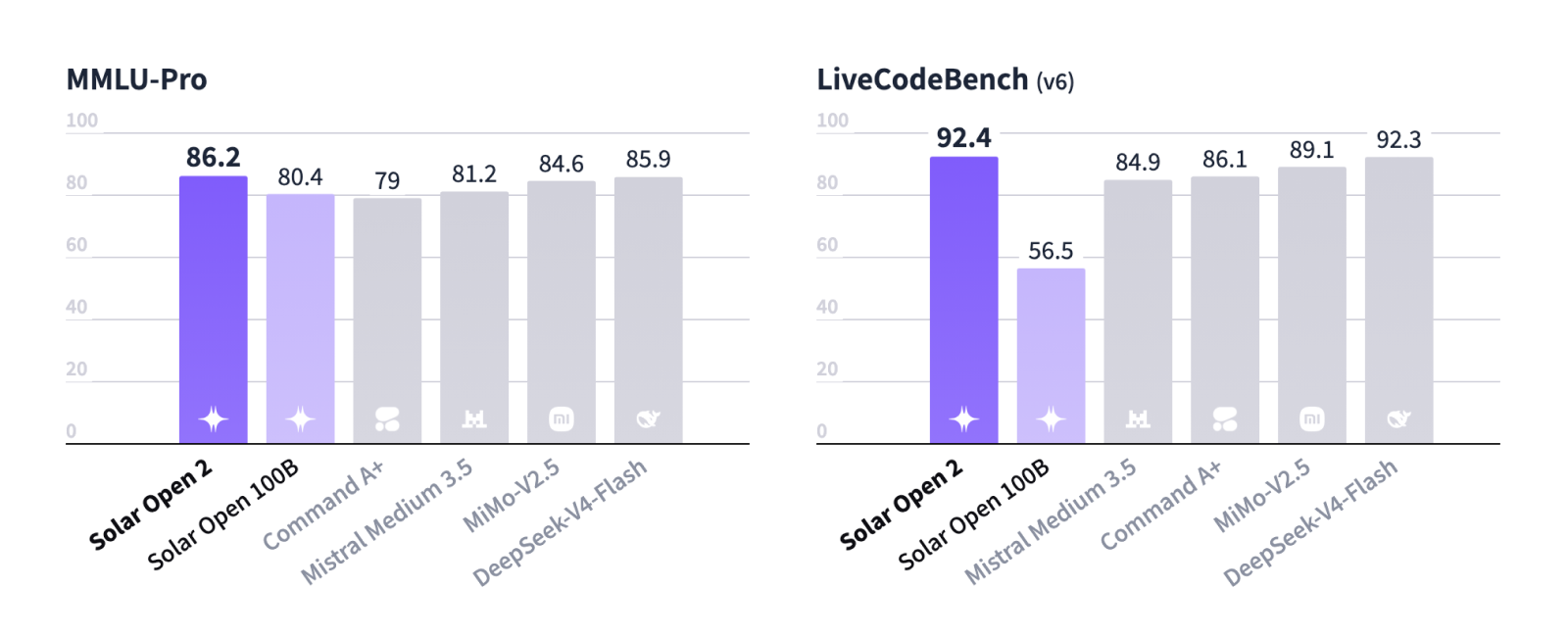
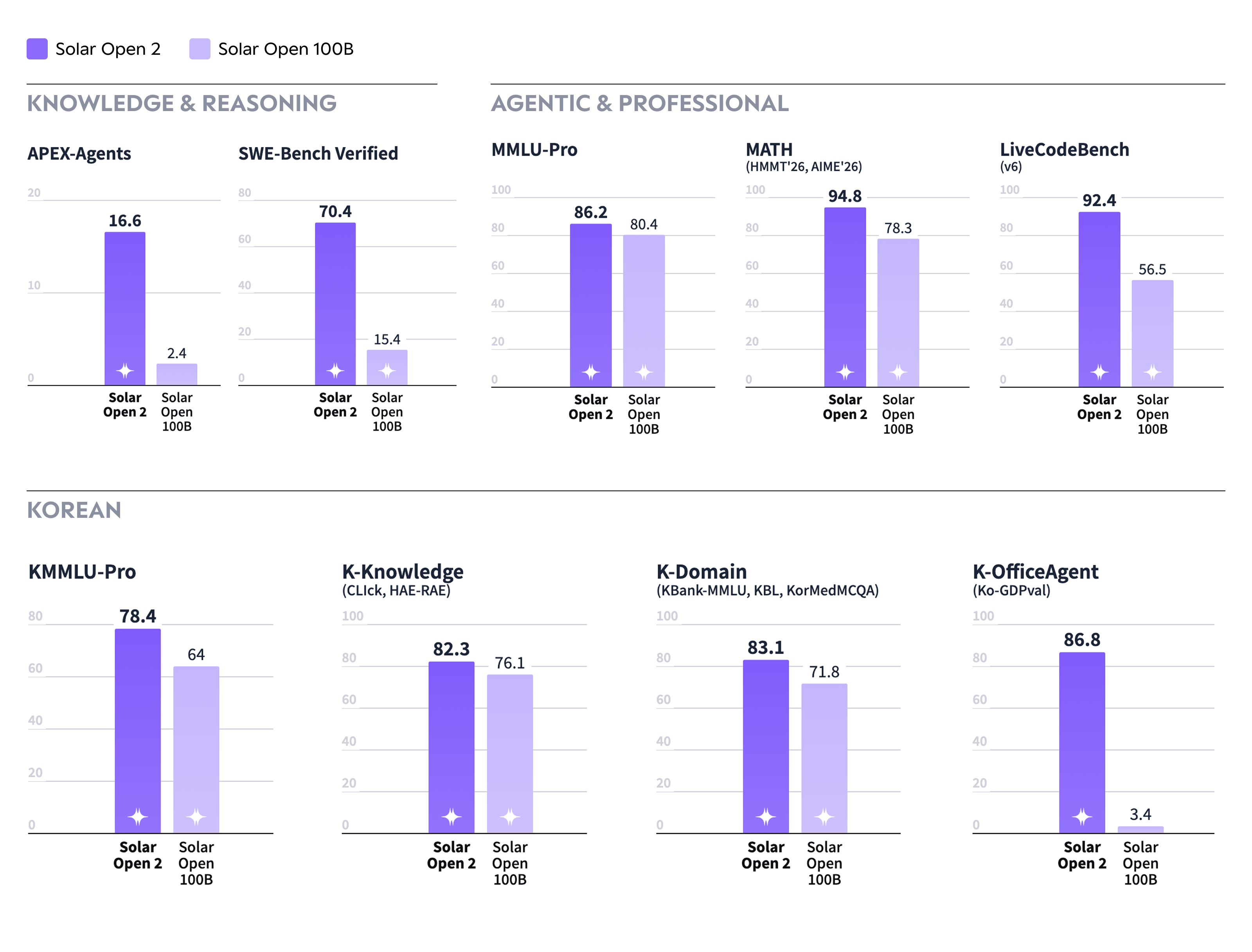
In our benchmark results, Solar Open 2 scored 86.2 on MMLU-Pro (knowledge) and 92.4 on LiveCodeBench (coding), the highest scores among comparable models.
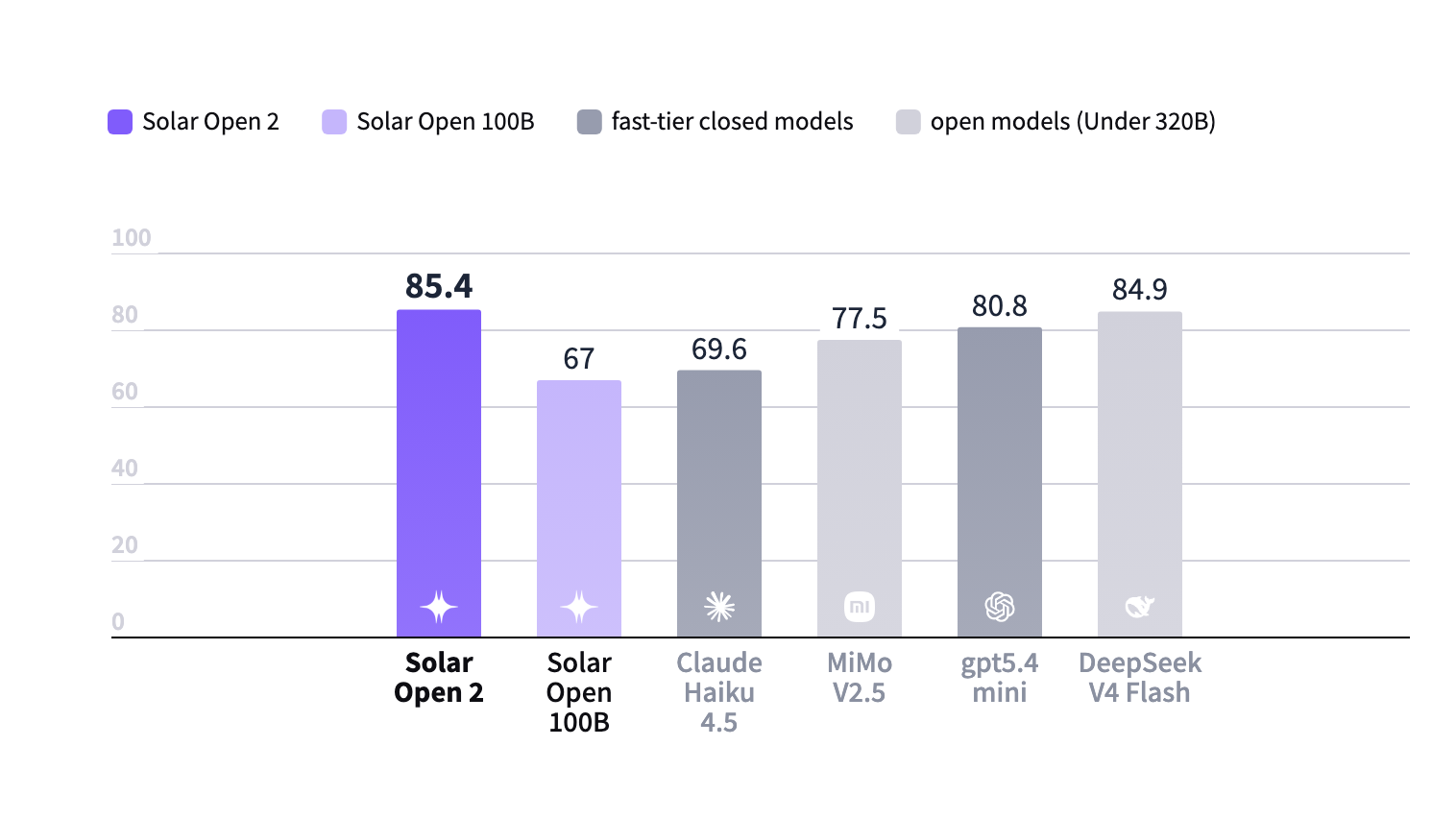
Its Korean benchmark average of 85.4 edges out DeepSeek-V4-Flash (84.9) and stands well ahead of fast-tier closed APIs such as GPT-5.4 mini (80.8) and Claude Haiku 4.5 (69.6).
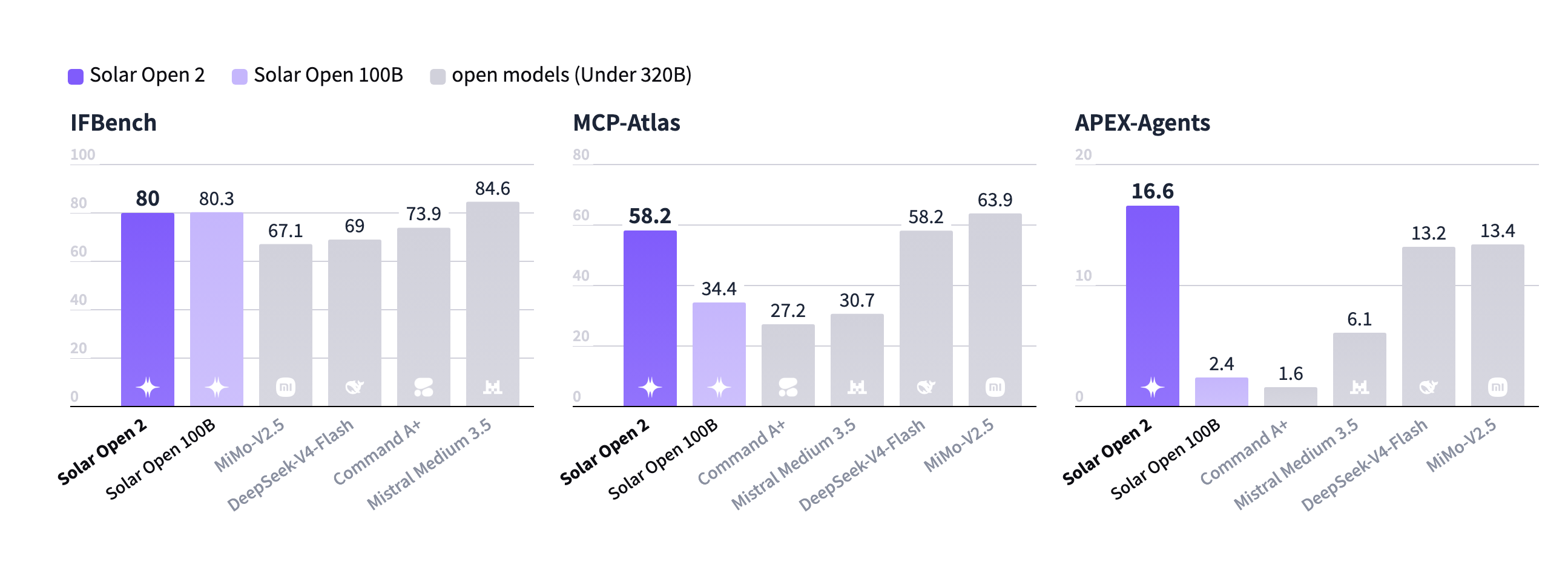
The model also proved competitive in instruction following and tool calling, the evaluations most directly tied to the reliability of agent services. It scored 80 on IFBench and 58.2 on MCP-Atlas, which puts it at the top of the group alongside DeepSeek-V4-Flash. On APEX-Agents, which evaluates real-work agent capability, it recorded 16.6, the highest score in the comparison.
Korean office work on par with a model six times larger

Ko-GDPval is a benchmark that evaluates an agent's ability to carry out work in real workplace settings. It consists of 170 real work scenarios across 58 professions, including lawyers, accountants, and infection-control specialists, and models are evaluated on deliverables they actually produce: reports, plans, and briefings.

On this benchmark, Solar Open 2 scored 86.8, just 0.16 points behind DeepSeek-V4-Pro (86.9), a 1.6T model more than six times its size, and ahead of every other model in the comparison, including the 1T-scale MiMo-V2.5-Pro (84.6).

The result is more striking in terms of active parameters: the parameters that actually take part in computing each token when an agent calls the model. Solar Open 2 uses 15B, about one third of DeepSeek-V4-Pro's. It handles the same work with a third of the computation, and in agent services where repeated calls accumulate, that gap shows up directly in operating costs.

Below are excerpts from deliverables Solar Open 2 actually submitted.

FATF mutual-evaluation pre-response, delivered in two mutually consistent formats. Left: the regulator-facing response report (PDF), summarizing transactions by risk grade and country exposure; right: the monitoring workbook (xlsx) listing all 55 rule-flagged (R1–R4) transactions.
Source fidelity and cited grounds across two regulatory-document tasks. Left: a medical-device PMS periodic report, with product identification and adverse-event severity tallies; right: a law firm's advertising self-inspection, with its cited-precedent table and statute index.

A major step up from the previous generation

Compared with our previous model, Solar Open 100B, Solar Open 2 improved substantially across knowledge, math, coding, and instruction following.

Category Benchmark Solar Open 100B Solar Open 2 Gain
Knowledge & science reasoning GPQA-Diamond 66.16 86.26 +20.10p
Math HMMT 68.94 93.94 +25.00p
Coding LiveCodeBench 56.49 92.42 +35.93p
Instruction following IFBench 57.70 80.00 +22.30p
Korean overall Korean average 66.95 85.43 +18.48p

This result comes from applying a new architecture, new data composition, and agent-centered training methodology on top of the weights and training experience accumulated in Solar Open 100B.
So anyone can verify it and build on it

The model weights of Solar Open 2 are released on Hugging Face. Under the Upstage Solar License, commercial use is permitted, as is derivative model development through fine-tuning and distillation. Anyone can deploy the model on their own infrastructure and evaluate it directly on internal data. It can also be adapted to specific domains and tasks, or distilled into smaller models that serve as the foundation for new agents and commercial services.

The rationale behind our architecture choices, the training methodology, key ablations, and evaluation conditions are all in the Technical Report. Rather than presenting final scores alone, we share in detail the problems we ran into during development and the technical know-how we built while solving them. This allows anyone to reproduce the benchmark results and verify Solar Open 2's technology and performance directly.

Sovereign AI takes more than a model built in a particular country. Users must be able to deploy and verify the model themselves, and hold control over their data and operating environment. They need environments where internal data never leaves the organization, and the freedom to modify the model and extend it into new services as their needs change.

This is why we're releasing Solar Open 2 as open weights. By sharing the technology and training experience we've invested in this model, we want to give the global LLM research and industry ecosystem, in Korea and beyond, a foundation for building new models and agent services.

Get started

Solar Open 2 is available through the following channels starting today:

Using it in Claude Code

curl -fsSL <https://console.upstage.ai/claude-upstage.sh> | bash

Using it in Hermes Agent

Solar Open 2 is a Hermes Official model. You can select it from the Hermes model list and start using it right away.

Trying it in Playground

You can also chat with Solar Open 2 in the Upstage Playground without any setup. The Playground trial is available through July 31.

Share your feedback and observations from using Solar Open 2 in the Hugging Face discussions. What works well and what falls short will feed directly into the next Solar. For adoption and other inquiries, reach us through our contact page.

Solar Open 2: Korea's Sovereign Foundation Model, Built for Agentic Use

Upstage Team
Upstage Team
Upstage Team
Upstage Team
July 22, 2026
Solar Open 2: Korea's Sovereign Foundation Model, Built for Agentic Use
We build intelligence for the future of work—now it’s your turn.

Start building with our API or talk to our team.

Share

Today we're releasing Solar Open 2, our open-weight foundation model optimized for agentic use.

Solar Open 2 is designed and trained to serve as the base model for agents in real work environments. It's trained on a wide range of agent scenarios, including tool calling, coding, and office work, and delivers performance that competes with leading global models across agent, Korean, knowledge, and coding benchmarks.

The model adopts an MoE architecture that activates only 15B of its 250B total parameters per token, improving capability and inference efficiency at the same time. With quantization, it runs on two NVIDIA H200 GPUs, which makes it practical for enterprises to deploy and operate on their own infrastructure. Built for agent tasks that run across many steps, it supports a context window of up to 1M tokens and comes with official support for Korean, English, and Japanese.

The model weights are released on Hugging Face under a commercially usable license. Alongside them, we publish the Solar Open 2 Technical Report, covering the full architecture, training methodology, key experiments, and evaluation conditions.

Key highlights

  • Designed and trained for agentic use, ready for real work environments
  • Competes with leading global models across agent, Korean, knowledge, and coding benchmarks
  • 250B total / 15B active MoE architecture for efficient inference
  • 1M-token context window
  • Runs on two H200 GPUs with quantization
  • Officially supports Korean, English, and Japanese
  • Released as open weights with commercial use permitted

From chat to agents

The role of LLMs is changing.

Until now, LLMs mostly generated a single answer to a user's question. They are now expanding into agents that search for information, read across documents, write code, and call external tools to carry real work through to completion.

The work agents handle is different in kind from chat. Instead of answering a short question, an agent repeats dozens of reasoning steps and tool calls. It has to work with information scattered across files and documents, remember what it has already done, and decide its next action accordingly. A mistake at one step can fail the entire task downstream.

Agentic use demands three capabilities.

  • First, long-horizon task execution: carrying multi-step work through to the end.
  • Second, long-context processing: holding long documents and work history in view.
  • Third, following instructions precisely and calling the right tools reliably.

These capabilities are hard to learn from ordinary question-answering data. The model needs to experience agent scenarios during training: search, tool calling, coding, document work. And the scenarios can't just look plausible. They have to reflect real work environments, and we have to be able to verify that the model actually completed the task.

Cost matters too. An agent doesn't stop at a single model call; it cycles through planning, execution, verification, and revision, so it typically uses far more tokens than chat. For an enterprise to deploy the model on its own infrastructure, the model can't be too large or too slow.

We built Solar Open 2 to be more than a model with high benchmark scores: a model with the performance and cost structure to power agents in real work environments.

Agent-centered training data

We developed Solar Open 2 with agentic use as a primary goal across both pre-training and post-training. Training scenarios cover search, tool calling (MCP), coding, and office work. The model learned not just to generate explanations, but to act in real environments, check the results, and correct itself when needed.

To build realistic agent training data, we developed our own data synthesis and verification pipeline. Starting from source data drawn from real work environments, we constructed settings where correct answers can be determined unambiguously, then repeated the process of selecting only the data that passed verification. Only this high-quality agent data went into training.

Search

Search agent data distinguishes between questions the model can answer with what it already knows and questions that require actual retrieval. Generated questions pass through multiple verification stages checking structure, non-triviality, searchability, solvability, and grounding in sources. This teaches the model to reach for search when it encounters knowledge it doesn't have.

Tool calling

Unlike conventional approaches that only judge whether the model selected the right tool, we have the model execute changes in a real environment, then read the changed state back to verify the result. The point is to separate generating a plausible answer from actually completing the task. This trains the model to take actions that can be trusted, not just to produce responses that sound right.

Coding

The coding agent works in a terminal, then writes and runs its own tests. When tests fail, the training data includes the loop of fixing the code and verifying again. The model learns how to work through long-horizon tasks: correcting mistakes and ultimately reaching the goal.

Office work

Office work scenarios reflect real working environments: cross-checking information scattered across documents and spreadsheets, changing inputs in a spreadsheet with formulas and recalculating the results, and other tasks close to actual daily work. We specifically included document handling and tool-use scenarios common in Korean workplaces. The goal was not just to generate fluent Korean, but to actually carry out work given in Korean.

A 1M-token context for long tasks

The longer an agent works, the more information it has to hold. To navigate a large codebase, compare multiple documents, and decide the next action based on earlier tool results, the model has to take in and process a long context.

Solar Open 2 supports a 1M-token context window. To support long context, it uses a Hybrid Attention architecture combining GQA (full softmax attention) with linear attention. The model repeats blocks of one GQA layer and three linear attention layers, applying linear attention to 75% of its 48 layers.

Linear attention layers manage sequence information in a fixed-size state. This avoids having every layer's KV-cache grow in proportion to context length, and reduces the memory burden of long inputs.

The softmax attention layers adopt NoPE, applying no positional encoding. This choice targets extrapolation: handling inputs longer than the lengths the model mainly saw in training.

The effect shows up in training efficiency as well. In a controlled comparison, the Solar Open 2 architecture reached in 210B tokens the MMLU performance that Solar Open 100B's all-softmax architecture needed 671B tokens to reach. The detailed comparison and design rationale are published in the Technical Report.

Inference efficiency for repeated calls

In an environment where agents call the model repeatedly, inference cost becomes product cost.

Solar Open 2 uses an MoE architecture that activates only 15B of its 250B total parameters per token. The design keeps the knowledge and representational capacity of a large model while lowering the active computation needed to process each token.

Solar Open 2's feedforward network (FFN) consists of 320 routed experts and 1 shared expert, with 8 experts selected per token. Unlike dense models that activate every parameter every time, it uses only the experts the input needs.

This inference-efficient architecture lets Solar Open 2 keep its performance while running on relatively small infrastructure: four NVIDIA H200s for the BF16 model, or two H200s with quantization.

We set these requirements with deployment in mind, not just research evaluation: enterprises running the model on their own infrastructure and connecting it to agent services. Detailed throughput and latency figures are provided in the model card.

A multilingual model efficient in Korean

Solar Open 2 uses a tokenizer optimized for token efficiency in Korean. As a result, it processes the same Korean text with only 50 to 80% of the tokens global models use. On Korean office-work text, Solar Open 2's tokenizer is the most efficient of the 12 we compared, about 24% ahead of the best-performing global model. Expressing the same content in fewer tokens means lower inference cost and a longer effective context.

Selective Weight Transfer for efficient training

To train a 250B-scale model more efficiently, we developed our own Selective Weight Transfer method. Instead of initializing every weight at random, we took our previous model, Solar Open 100B, selected only the weights that could carry over to the new architecture, and used them to initialize Solar Open 2.

The figure shows a 200B-A15B proxy experiment in which the architecture, training data, and optimizer are held identical and only the initialization differs. The model with Selective Weight Transfer reached the target training loss in about 12B tokens, while the randomly initialized model needed about 22B. In other words, the transferred model reached the same loss with about 58% of the tokens, while random initialization took about 1.7 times more. This shows that even across different architectures, reusing the core representations alone lets the model reach the target performance level faster, with fewer training tokens.

Selective Weight Transfer is our own approach to reducing training time and compute. With this release, we improved both the model's performance and the efficiency of the process that builds it.

Benchmarks

First among comparable models in MMLU-Pro, LiveCodeBench, and Korean benchmarks

Beyond agentic use, Korean-language performance, and inference efficiency, Solar Open 2 is also competitive in core knowledge and coding.

In our benchmark results, Solar Open 2 scored 86.2 on MMLU-Pro (knowledge) and 92.4 on LiveCodeBench (coding), the highest scores among comparable models.

Its Korean benchmark average of 85.4 edges out DeepSeek-V4-Flash (84.9) and stands well ahead of fast-tier closed APIs such as GPT-5.4 mini (80.8) and Claude Haiku 4.5 (69.6).

The model also proved competitive in instruction following and tool calling, the evaluations most directly tied to the reliability of agent services. It scored 80 on IFBench and 58.2 on MCP-Atlas, which puts it at the top of the group alongside DeepSeek-V4-Flash. On APEX-Agents, which evaluates real-work agent capability, it recorded 16.6, the highest score in the comparison.

Korean office work on par with a model six times larger

Ko-GDPval is a benchmark that evaluates an agent's ability to carry out work in real workplace settings. It consists of 170 real work scenarios across 58 professions, including lawyers, accountants, and infection-control specialists, and models are evaluated on deliverables they actually produce: reports, plans, and briefings.

On this benchmark, Solar Open 2 scored 86.8, just 0.16 points behind DeepSeek-V4-Pro (86.9), a 1.6T model more than six times its size, and ahead of every other model in the comparison, including the 1T-scale MiMo-V2.5-Pro (84.6).

The result is more striking in terms of active parameters: the parameters that actually take part in computing each token when an agent calls the model. Solar Open 2 uses 15B, about one third of DeepSeek-V4-Pro's. It handles the same work with a third of the computation, and in agent services where repeated calls accumulate, that gap shows up directly in operating costs.

Below are excerpts from deliverables Solar Open 2 actually submitted.

FATF mutual-evaluation pre-response, delivered in two mutually consistent formats. Left: the regulator-facing response report (PDF), summarizing transactions by risk grade and country exposure; right: the monitoring workbook (xlsx) listing all 55 rule-flagged (R1–R4) transactions.
Source fidelity and cited grounds across two regulatory-document tasks. Left: a medical-device PMS periodic report, with product identification and adverse-event severity tallies; right: a law firm's advertising self-inspection, with its cited-precedent table and statute index.

A major step up from the previous generation

Compared with our previous model, Solar Open 100B, Solar Open 2 improved substantially across knowledge, math, coding, and instruction following.

Category Benchmark Solar Open 100B Solar Open 2 Gain
Knowledge & science reasoning GPQA-Diamond 66.16 86.26 +20.10p
Math HMMT 68.94 93.94 +25.00p
Coding LiveCodeBench 56.49 92.42 +35.93p
Instruction following IFBench 57.70 80.00 +22.30p
Korean overall Korean average 66.95 85.43 +18.48p

This result comes from applying a new architecture, new data composition, and agent-centered training methodology on top of the weights and training experience accumulated in Solar Open 100B.

So anyone can verify it and build on it

The model weights of Solar Open 2 are released on Hugging Face. Under the Upstage Solar License, commercial use is permitted, as is derivative model development through fine-tuning and distillation. Anyone can deploy the model on their own infrastructure and evaluate it directly on internal data. It can also be adapted to specific domains and tasks, or distilled into smaller models that serve as the foundation for new agents and commercial services.

The rationale behind our architecture choices, the training methodology, key ablations, and evaluation conditions are all in the Technical Report. Rather than presenting final scores alone, we share in detail the problems we ran into during development and the technical know-how we built while solving them. This allows anyone to reproduce the benchmark results and verify Solar Open 2's technology and performance directly.

Sovereign AI takes more than a model built in a particular country. Users must be able to deploy and verify the model themselves, and hold control over their data and operating environment. They need environments where internal data never leaves the organization, and the freedom to modify the model and extend it into new services as their needs change.

This is why we're releasing Solar Open 2 as open weights. By sharing the technology and training experience we've invested in this model, we want to give the global LLM research and industry ecosystem, in Korea and beyond, a foundation for building new models and agent services.

Get started

Solar Open 2 is available through the following channels starting today:

Using it in Claude Code

curl -fsSL <https://console.upstage.ai/claude-upstage.sh> | bash

Using it in Hermes Agent

Solar Open 2 is a Hermes Official model. You can select it from the Hermes model list and start using it right away.

Trying it in Playground

You can also chat with Solar Open 2 in the Upstage Playground without any setup. The Playground trial is available through July 31.

Share your feedback and observations from using Solar Open 2 in the Hugging Face discussions. What works well and what falls short will feed directly into the next Solar. For adoption and other inquiries, reach us through our contact page.

Today we're releasing Solar Open 2, our open-weight foundation model optimized for agentic use.

Solar Open 2 is designed and trained to serve as the base model for agents in real work environments. It's trained on a wide range of agent scenarios, including tool calling, coding, and office work, and delivers performance that competes with leading global models across agent, Korean, knowledge, and coding benchmarks.

The model adopts an MoE architecture that activates only 15B of its 250B total parameters per token, improving capability and inference efficiency at the same time. With quantization, it runs on two NVIDIA H200 GPUs, which makes it practical for enterprises to deploy and operate on their own infrastructure. Built for agent tasks that run across many steps, it supports a context window of up to 1M tokens and comes with official support for Korean, English, and Japanese.

The model weights are released on Hugging Face under a commercially usable license. Alongside them, we publish the Solar Open 2 Technical Report, covering the full architecture, training methodology, key experiments, and evaluation conditions.

Key highlights

  • Designed and trained for agentic use, ready for real work environments
  • Competes with leading global models across agent, Korean, knowledge, and coding benchmarks
  • 250B total / 15B active MoE architecture for efficient inference
  • 1M-token context window
  • Runs on two H200 GPUs with quantization
  • Officially supports Korean, English, and Japanese
  • Released as open weights with commercial use permitted

From chat to agents

The role of LLMs is changing.

Until now, LLMs mostly generated a single answer to a user's question. They are now expanding into agents that search for information, read across documents, write code, and call external tools to carry real work through to completion.

The work agents handle is different in kind from chat. Instead of answering a short question, an agent repeats dozens of reasoning steps and tool calls. It has to work with information scattered across files and documents, remember what it has already done, and decide its next action accordingly. A mistake at one step can fail the entire task downstream.

Agentic use demands three capabilities.

  • First, long-horizon task execution: carrying multi-step work through to the end.
  • Second, long-context processing: holding long documents and work history in view.
  • Third, following instructions precisely and calling the right tools reliably.

These capabilities are hard to learn from ordinary question-answering data. The model needs to experience agent scenarios during training: search, tool calling, coding, document work. And the scenarios can't just look plausible. They have to reflect real work environments, and we have to be able to verify that the model actually completed the task.

Cost matters too. An agent doesn't stop at a single model call; it cycles through planning, execution, verification, and revision, so it typically uses far more tokens than chat. For an enterprise to deploy the model on its own infrastructure, the model can't be too large or too slow.

We built Solar Open 2 to be more than a model with high benchmark scores: a model with the performance and cost structure to power agents in real work environments.

Agent-centered training data

We developed Solar Open 2 with agentic use as a primary goal across both pre-training and post-training. Training scenarios cover search, tool calling (MCP), coding, and office work. The model learned not just to generate explanations, but to act in real environments, check the results, and correct itself when needed.

To build realistic agent training data, we developed our own data synthesis and verification pipeline. Starting from source data drawn from real work environments, we constructed settings where correct answers can be determined unambiguously, then repeated the process of selecting only the data that passed verification. Only this high-quality agent data went into training.

Search

Search agent data distinguishes between questions the model can answer with what it already knows and questions that require actual retrieval. Generated questions pass through multiple verification stages checking structure, non-triviality, searchability, solvability, and grounding in sources. This teaches the model to reach for search when it encounters knowledge it doesn't have.

Tool calling

Unlike conventional approaches that only judge whether the model selected the right tool, we have the model execute changes in a real environment, then read the changed state back to verify the result. The point is to separate generating a plausible answer from actually completing the task. This trains the model to take actions that can be trusted, not just to produce responses that sound right.

Coding

The coding agent works in a terminal, then writes and runs its own tests. When tests fail, the training data includes the loop of fixing the code and verifying again. The model learns how to work through long-horizon tasks: correcting mistakes and ultimately reaching the goal.

Office work

Office work scenarios reflect real working environments: cross-checking information scattered across documents and spreadsheets, changing inputs in a spreadsheet with formulas and recalculating the results, and other tasks close to actual daily work. We specifically included document handling and tool-use scenarios common in Korean workplaces. The goal was not just to generate fluent Korean, but to actually carry out work given in Korean.

A 1M-token context for long tasks

The longer an agent works, the more information it has to hold. To navigate a large codebase, compare multiple documents, and decide the next action based on earlier tool results, the model has to take in and process a long context.

Solar Open 2 supports a 1M-token context window. To support long context, it uses a Hybrid Attention architecture combining GQA (full softmax attention) with linear attention. The model repeats blocks of one GQA layer and three linear attention layers, applying linear attention to 75% of its 48 layers.

Linear attention layers manage sequence information in a fixed-size state. This avoids having every layer's KV-cache grow in proportion to context length, and reduces the memory burden of long inputs.

The softmax attention layers adopt NoPE, applying no positional encoding. This choice targets extrapolation: handling inputs longer than the lengths the model mainly saw in training.

The effect shows up in training efficiency as well. In a controlled comparison, the Solar Open 2 architecture reached in 210B tokens the MMLU performance that Solar Open 100B's all-softmax architecture needed 671B tokens to reach. The detailed comparison and design rationale are published in the Technical Report.

Inference efficiency for repeated calls

In an environment where agents call the model repeatedly, inference cost becomes product cost.

Solar Open 2 uses an MoE architecture that activates only 15B of its 250B total parameters per token. The design keeps the knowledge and representational capacity of a large model while lowering the active computation needed to process each token.

Solar Open 2's feedforward network (FFN) consists of 320 routed experts and 1 shared expert, with 8 experts selected per token. Unlike dense models that activate every parameter every time, it uses only the experts the input needs.

This inference-efficient architecture lets Solar Open 2 keep its performance while running on relatively small infrastructure: four NVIDIA H200s for the BF16 model, or two H200s with quantization.

We set these requirements with deployment in mind, not just research evaluation: enterprises running the model on their own infrastructure and connecting it to agent services. Detailed throughput and latency figures are provided in the model card.

A multilingual model efficient in Korean

Solar Open 2 uses a tokenizer optimized for token efficiency in Korean. As a result, it processes the same Korean text with only 50 to 80% of the tokens global models use. On Korean office-work text, Solar Open 2's tokenizer is the most efficient of the 12 we compared, about 24% ahead of the best-performing global model. Expressing the same content in fewer tokens means lower inference cost and a longer effective context.

Selective Weight Transfer for efficient training

To train a 250B-scale model more efficiently, we developed our own Selective Weight Transfer method. Instead of initializing every weight at random, we took our previous model, Solar Open 100B, selected only the weights that could carry over to the new architecture, and used them to initialize Solar Open 2.

The figure shows a 200B-A15B proxy experiment in which the architecture, training data, and optimizer are held identical and only the initialization differs. The model with Selective Weight Transfer reached the target training loss in about 12B tokens, while the randomly initialized model needed about 22B. In other words, the transferred model reached the same loss with about 58% of the tokens, while random initialization took about 1.7 times more. This shows that even across different architectures, reusing the core representations alone lets the model reach the target performance level faster, with fewer training tokens.

Selective Weight Transfer is our own approach to reducing training time and compute. With this release, we improved both the model's performance and the efficiency of the process that builds it.

Benchmarks

First among comparable models in MMLU-Pro, LiveCodeBench, and Korean benchmarks

Beyond agentic use, Korean-language performance, and inference efficiency, Solar Open 2 is also competitive in core knowledge and coding.

In our benchmark results, Solar Open 2 scored 86.2 on MMLU-Pro (knowledge) and 92.4 on LiveCodeBench (coding), the highest scores among comparable models.

Its Korean benchmark average of 85.4 edges out DeepSeek-V4-Flash (84.9) and stands well ahead of fast-tier closed APIs such as GPT-5.4 mini (80.8) and Claude Haiku 4.5 (69.6).

The model also proved competitive in instruction following and tool calling, the evaluations most directly tied to the reliability of agent services. It scored 80 on IFBench and 58.2 on MCP-Atlas, which puts it at the top of the group alongside DeepSeek-V4-Flash. On APEX-Agents, which evaluates real-work agent capability, it recorded 16.6, the highest score in the comparison.

Korean office work on par with a model six times larger

Ko-GDPval is a benchmark that evaluates an agent's ability to carry out work in real workplace settings. It consists of 170 real work scenarios across 58 professions, including lawyers, accountants, and infection-control specialists, and models are evaluated on deliverables they actually produce: reports, plans, and briefings.

On this benchmark, Solar Open 2 scored 86.8, just 0.16 points behind DeepSeek-V4-Pro (86.9), a 1.6T model more than six times its size, and ahead of every other model in the comparison, including the 1T-scale MiMo-V2.5-Pro (84.6).

The result is more striking in terms of active parameters: the parameters that actually take part in computing each token when an agent calls the model. Solar Open 2 uses 15B, about one third of DeepSeek-V4-Pro's. It handles the same work with a third of the computation, and in agent services where repeated calls accumulate, that gap shows up directly in operating costs.

Below are excerpts from deliverables Solar Open 2 actually submitted.

FATF mutual-evaluation pre-response, delivered in two mutually consistent formats. Left: the regulator-facing response report (PDF), summarizing transactions by risk grade and country exposure; right: the monitoring workbook (xlsx) listing all 55 rule-flagged (R1–R4) transactions.
Source fidelity and cited grounds across two regulatory-document tasks. Left: a medical-device PMS periodic report, with product identification and adverse-event severity tallies; right: a law firm's advertising self-inspection, with its cited-precedent table and statute index.

A major step up from the previous generation

Compared with our previous model, Solar Open 100B, Solar Open 2 improved substantially across knowledge, math, coding, and instruction following.

Category Benchmark Solar Open 100B Solar Open 2 Gain
Knowledge & science reasoning GPQA-Diamond 66.16 86.26 +20.10p
Math HMMT 68.94 93.94 +25.00p
Coding LiveCodeBench 56.49 92.42 +35.93p
Instruction following IFBench 57.70 80.00 +22.30p
Korean overall Korean average 66.95 85.43 +18.48p

This result comes from applying a new architecture, new data composition, and agent-centered training methodology on top of the weights and training experience accumulated in Solar Open 100B.

So anyone can verify it and build on it

The model weights of Solar Open 2 are released on Hugging Face. Under the Upstage Solar License, commercial use is permitted, as is derivative model development through fine-tuning and distillation. Anyone can deploy the model on their own infrastructure and evaluate it directly on internal data. It can also be adapted to specific domains and tasks, or distilled into smaller models that serve as the foundation for new agents and commercial services.

The rationale behind our architecture choices, the training methodology, key ablations, and evaluation conditions are all in the Technical Report. Rather than presenting final scores alone, we share in detail the problems we ran into during development and the technical know-how we built while solving them. This allows anyone to reproduce the benchmark results and verify Solar Open 2's technology and performance directly.

Sovereign AI takes more than a model built in a particular country. Users must be able to deploy and verify the model themselves, and hold control over their data and operating environment. They need environments where internal data never leaves the organization, and the freedom to modify the model and extend it into new services as their needs change.

This is why we're releasing Solar Open 2 as open weights. By sharing the technology and training experience we've invested in this model, we want to give the global LLM research and industry ecosystem, in Korea and beyond, a foundation for building new models and agent services.

Get started

Solar Open 2 is available through the following channels starting today:

Using it in Claude Code

curl -fsSL <https://console.upstage.ai/claude-upstage.sh> | bash

Using it in Hermes Agent

Solar Open 2 is a Hermes Official model. You can select it from the Hermes model list and start using it right away.

Trying it in Playground

You can also chat with Solar Open 2 in the Upstage Playground without any setup. The Playground trial is available through July 31.

Share your feedback and observations from using Solar Open 2 in the Hugging Face discussions. What works well and what falls short will feed directly into the next Solar. For adoption and other inquiries, reach us through our contact page.

The 90-Day path to Underwriting Reinvention

See how Fortune 500 companies eliminate the bottleneck where 70% of submissions arrive incomplete.
1,000+
Submissions Analyzed
90
Days to Transform

Download the White Paper

Thank you! Your submission has been received!
Oops! Something went wrong while submitting the form.